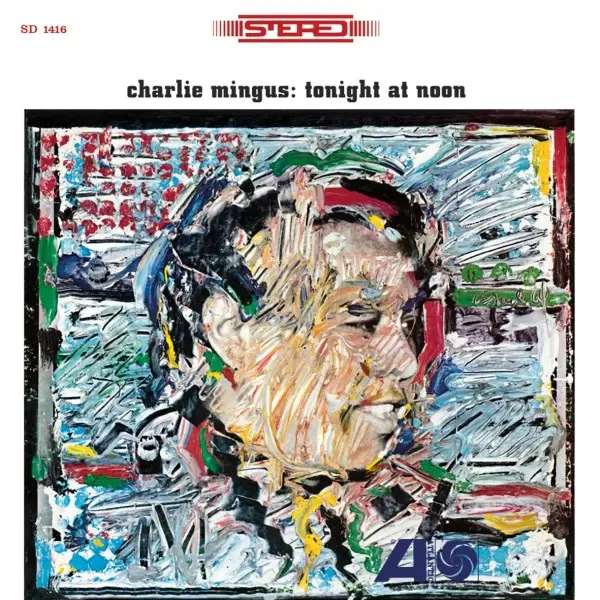
Tonight At Noon
Tonight At Noon compiles tracks from two earlier recordings sessions: one session from 1957 with Jimmy Knepper on the trombone, the drummer Dannie Richmond, Saxophone player Shafi Hadi and the pianist Wade Legge, which were released on the album "The Clown" (Atlantic 1260). The second session took place in 1961 with Booker Ervin and Roland Kirk on the saxophone, Knepper, the bassist Doug Watkins, Mingus at the piano and Richmond on the drums, and was released on "Oh Yeah" (Atlantic SD 1377).
The two sets differ in mood, but this does not mean that it is an album that uses leftovers. While Mingus in the first session strives for European harmonics and melodic approaches with a hard bop tempo (particularly on the title track) in the direction of the blues, the second session with its vespertine elegance and spatial explorations comes over rather as a sort of exercise à la avantgard Ellington with sophisticated harmonies that pave the way for sluggish marches and gospel-like blues. Kirk and Ervin complement one another particularly well, their swing is appararently boundless. Mingus’s piano playing is deeply rooted in the blues, and his sense of tempo and lightness anhances these numbers, particularly in "‘Old’ Blues for Walt’s Torin".
In these compositions one already finds hints of Mingus’s later recordings. The most beautiful number is taken from the 1957 session and concludes the album: "Passions Of A Woman Loved", almost ten minutes in length, feels like an Ellington suite. Although, or maybe simply because several years passed between the two sessions, one cannot deny this album’s magic.
Original: $73.34
-70%$73.34
$22.00Tonight At Noon
Tonight At Noon compiles tracks from two earlier recordings sessions: one session from 1957 with Jimmy Knepper on the trombone, the drummer Dannie Richmond, Saxophone player Shafi Hadi and the pianist Wade Legge, which were released on the album "The Clown" (Atlantic 1260). The second session took place in 1961 with Booker Ervin and Roland Kirk on the saxophone, Knepper, the bassist Doug Watkins, Mingus at the piano and Richmond on the drums, and was released on "Oh Yeah" (Atlantic SD 1377).
The two sets differ in mood, but this does not mean that it is an album that uses leftovers. While Mingus in the first session strives for European harmonics and melodic approaches with a hard bop tempo (particularly on the title track) in the direction of the blues, the second session with its vespertine elegance and spatial explorations comes over rather as a sort of exercise à la avantgard Ellington with sophisticated harmonies that pave the way for sluggish marches and gospel-like blues. Kirk and Ervin complement one another particularly well, their swing is appararently boundless. Mingus’s piano playing is deeply rooted in the blues, and his sense of tempo and lightness anhances these numbers, particularly in "‘Old’ Blues for Walt’s Torin".
In these compositions one already finds hints of Mingus’s later recordings. The most beautiful number is taken from the 1957 session and concludes the album: "Passions Of A Woman Loved", almost ten minutes in length, feels like an Ellington suite. Although, or maybe simply because several years passed between the two sessions, one cannot deny this album’s magic.
Product Information
Product Information
Shipping & Returns
Shipping & Returns
Description
Tonight At Noon compiles tracks from two earlier recordings sessions: one session from 1957 with Jimmy Knepper on the trombone, the drummer Dannie Richmond, Saxophone player Shafi Hadi and the pianist Wade Legge, which were released on the album "The Clown" (Atlantic 1260). The second session took place in 1961 with Booker Ervin and Roland Kirk on the saxophone, Knepper, the bassist Doug Watkins, Mingus at the piano and Richmond on the drums, and was released on "Oh Yeah" (Atlantic SD 1377).
The two sets differ in mood, but this does not mean that it is an album that uses leftovers. While Mingus in the first session strives for European harmonics and melodic approaches with a hard bop tempo (particularly on the title track) in the direction of the blues, the second session with its vespertine elegance and spatial explorations comes over rather as a sort of exercise à la avantgard Ellington with sophisticated harmonies that pave the way for sluggish marches and gospel-like blues. Kirk and Ervin complement one another particularly well, their swing is appararently boundless. Mingus’s piano playing is deeply rooted in the blues, and his sense of tempo and lightness anhances these numbers, particularly in "‘Old’ Blues for Walt’s Torin".
In these compositions one already finds hints of Mingus’s later recordings. The most beautiful number is taken from the 1957 session and concludes the album: "Passions Of A Woman Loved", almost ten minutes in length, feels like an Ellington suite. Although, or maybe simply because several years passed between the two sessions, one cannot deny this album’s magic.