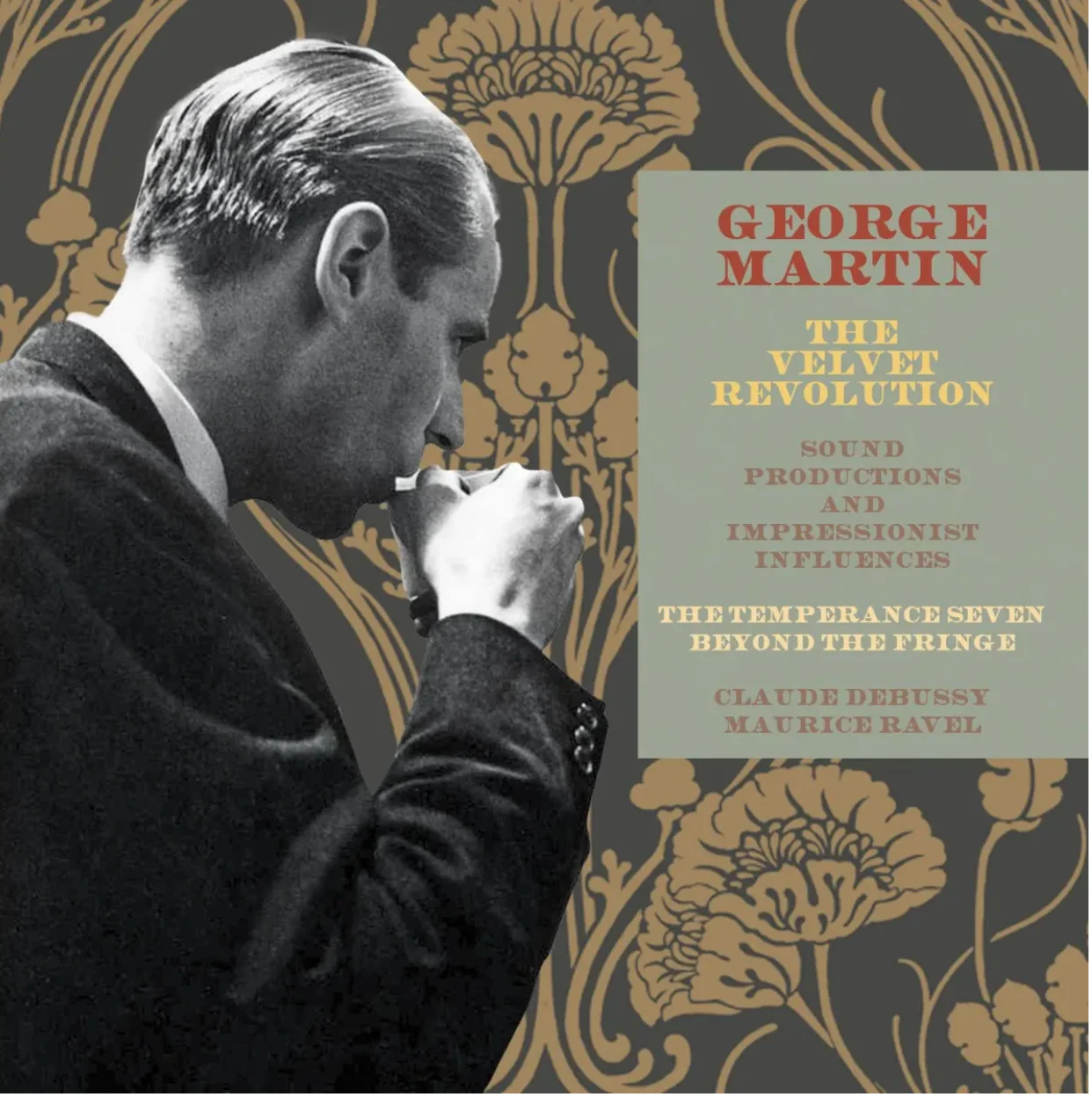
The Velvet Revolution - Sound Productions and Impressionist Influences,
George Martin's work with the Beatles defined the sixties and changed music forever.
As Paul McCartney said, ‘if anyone was the fifth Beatle it was him’.
During the 1950's, Martin, a great appreciator of quirkiness, established the Parlophone label with a sequence of ingenious comedy records by The Goons, Peter Ustinov and Flanders and Swann; a precocious formula which caught the mood of the time and yielded hits for Bernard Cribbins and Peter Sellers and Sophia Loren. Then, in 1961, while George was in Cambridge recording Peter Cook, Dudley Moore, Alan Bennett and Jonathan Miller in the groundbreaking satirical revue, Beyond the Fringe, came news of of the label's first Number One hit, 'You're Driving Me Crazy' by the whimsical 1920's-style dance band, The Temperance Seven.
Martin described his productions as "Sound Pictures". He would coax a performance from the artist, the result sometimes embellished by sound effects and other imaginative acoustic devices.
The techniques George mastered while creating comedy records had everything to do with the production triumphs that would follow with The Beatles. When the band retired from touring and determined to concentrate on making albums with a pioneering approach to the whole new art of pop, Martin was well equipped to meet the group's challenging sonic demands and to propose a good many initiatives of his own; whether in the string quartet setting for ‘Yesterday', or when taking an orchestra into uncharted musical waters for 'A Day In the Life'.
George Martin had a very particular affection for the Impressionist composers Claude Debussy and Maurice Ravel. He claimed the former's ‘Prélude à l'après-midi d’un faune' was the piece that decided him on a career in music and saw ‘Strawberry Fields Forever' as a Debusseyesque tone poem. For George, Ravel was “one of the greatest orchestrators of all time", with the “choreographic symphony”, ‘Daphnis and Chloe’ a particular favourite.
This 3CD presentation comprises all of George Martin's productions for the Temperance Seven, the sheer surrealist-comic electricity he captured of Beyond the Fringe, (including the original chart album) and a selection of works by Debussy and Ravel, including Igor Markevitch's account of Debussy's 'Faun' made at Abbey Road and 'Daybreak' from Pierre Monteux's ravishing 'Daphnis and Chloe' with the London Symphony Orchestra.
The Velvet Revolution - Sound Productions and Impressionist Influences,
George Martin's work with the Beatles defined the sixties and changed music forever.
As Paul McCartney said, ‘if anyone was the fifth Beatle it was him’.
During the 1950's, Martin, a great appreciator of quirkiness, established the Parlophone label with a sequence of ingenious comedy records by The Goons, Peter Ustinov and Flanders and Swann; a precocious formula which caught the mood of the time and yielded hits for Bernard Cribbins and Peter Sellers and Sophia Loren. Then, in 1961, while George was in Cambridge recording Peter Cook, Dudley Moore, Alan Bennett and Jonathan Miller in the groundbreaking satirical revue, Beyond the Fringe, came news of of the label's first Number One hit, 'You're Driving Me Crazy' by the whimsical 1920's-style dance band, The Temperance Seven.
Martin described his productions as "Sound Pictures". He would coax a performance from the artist, the result sometimes embellished by sound effects and other imaginative acoustic devices.
The techniques George mastered while creating comedy records had everything to do with the production triumphs that would follow with The Beatles. When the band retired from touring and determined to concentrate on making albums with a pioneering approach to the whole new art of pop, Martin was well equipped to meet the group's challenging sonic demands and to propose a good many initiatives of his own; whether in the string quartet setting for ‘Yesterday', or when taking an orchestra into uncharted musical waters for 'A Day In the Life'.
George Martin had a very particular affection for the Impressionist composers Claude Debussy and Maurice Ravel. He claimed the former's ‘Prélude à l'après-midi d’un faune' was the piece that decided him on a career in music and saw ‘Strawberry Fields Forever' as a Debusseyesque tone poem. For George, Ravel was “one of the greatest orchestrators of all time", with the “choreographic symphony”, ‘Daphnis and Chloe’ a particular favourite.
This 3CD presentation comprises all of George Martin's productions for the Temperance Seven, the sheer surrealist-comic electricity he captured of Beyond the Fringe, (including the original chart album) and a selection of works by Debussy and Ravel, including Igor Markevitch's account of Debussy's 'Faun' made at Abbey Road and 'Daybreak' from Pierre Monteux's ravishing 'Daphnis and Chloe' with the London Symphony Orchestra.
Product Information
Product Information
Shipping & Returns
Shipping & Returns
Description
George Martin's work with the Beatles defined the sixties and changed music forever.
As Paul McCartney said, ‘if anyone was the fifth Beatle it was him’.
During the 1950's, Martin, a great appreciator of quirkiness, established the Parlophone label with a sequence of ingenious comedy records by The Goons, Peter Ustinov and Flanders and Swann; a precocious formula which caught the mood of the time and yielded hits for Bernard Cribbins and Peter Sellers and Sophia Loren. Then, in 1961, while George was in Cambridge recording Peter Cook, Dudley Moore, Alan Bennett and Jonathan Miller in the groundbreaking satirical revue, Beyond the Fringe, came news of of the label's first Number One hit, 'You're Driving Me Crazy' by the whimsical 1920's-style dance band, The Temperance Seven.
Martin described his productions as "Sound Pictures". He would coax a performance from the artist, the result sometimes embellished by sound effects and other imaginative acoustic devices.
The techniques George mastered while creating comedy records had everything to do with the production triumphs that would follow with The Beatles. When the band retired from touring and determined to concentrate on making albums with a pioneering approach to the whole new art of pop, Martin was well equipped to meet the group's challenging sonic demands and to propose a good many initiatives of his own; whether in the string quartet setting for ‘Yesterday', or when taking an orchestra into uncharted musical waters for 'A Day In the Life'.
George Martin had a very particular affection for the Impressionist composers Claude Debussy and Maurice Ravel. He claimed the former's ‘Prélude à l'après-midi d’un faune' was the piece that decided him on a career in music and saw ‘Strawberry Fields Forever' as a Debusseyesque tone poem. For George, Ravel was “one of the greatest orchestrators of all time", with the “choreographic symphony”, ‘Daphnis and Chloe’ a particular favourite.
This 3CD presentation comprises all of George Martin's productions for the Temperance Seven, the sheer surrealist-comic electricity he captured of Beyond the Fringe, (including the original chart album) and a selection of works by Debussy and Ravel, including Igor Markevitch's account of Debussy's 'Faun' made at Abbey Road and 'Daybreak' from Pierre Monteux's ravishing 'Daphnis and Chloe' with the London Symphony Orchestra.