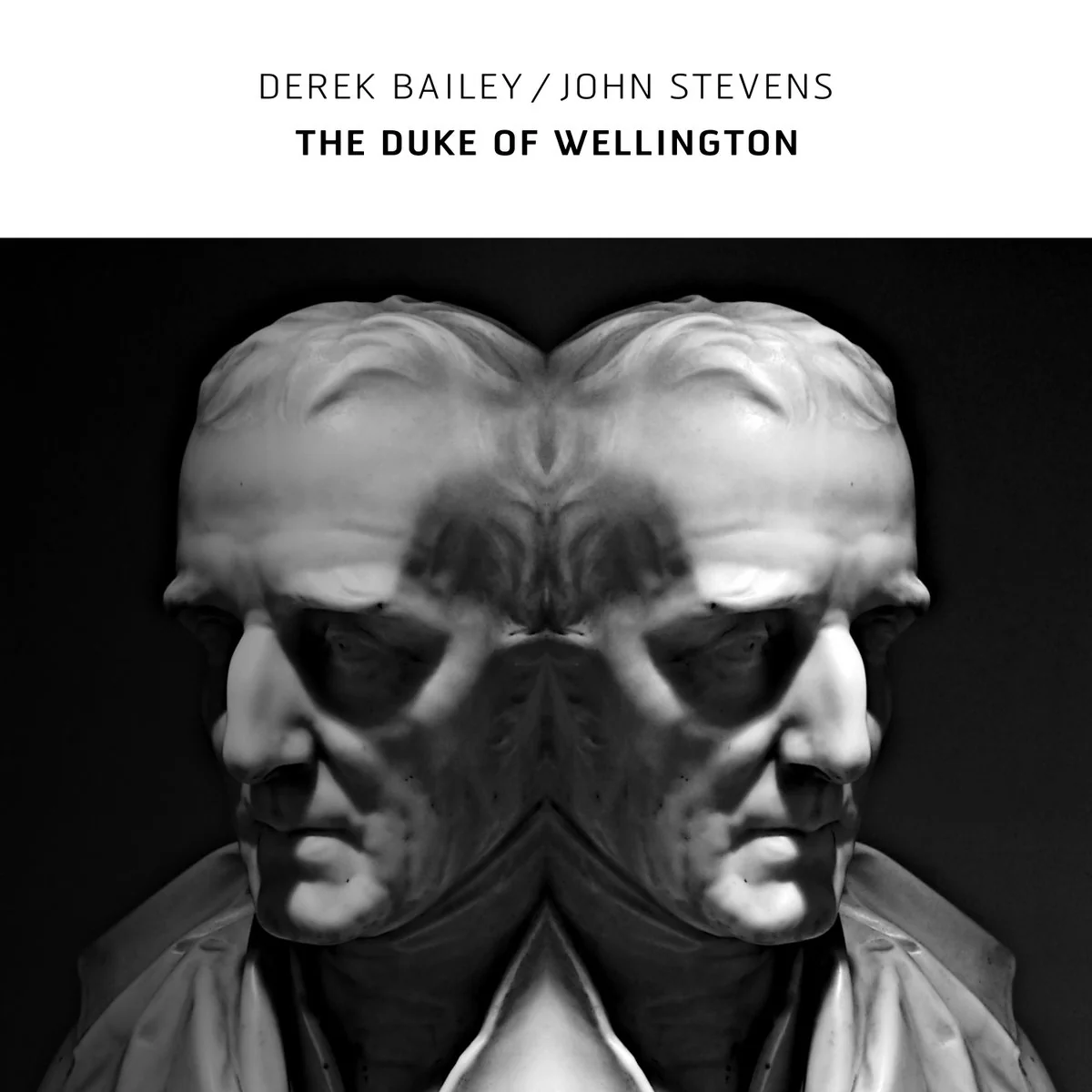
The Duke of Wellington
"For the second time in a matter of weeks, here we have an opportunity to hear more from guitarist Derek Bailey, this time performing with John Stevens. Neither man should need much by way of introduction: both were seminal figures in the world of free improvised music as it took shape in the 1960s and 70s. Thanks to Michael Gurzon’s recording, here they are, in 1989, performing together at The Duke of Wellington in London. The first track, ‘I’m Alright Actually’, begins with a series of slippery shapes, the noise-elements of Bailey’s guitar merging with those of Stevens’ percussion in a non-stop stream of invention. The music reaches a point of stasis before moving off into a series of angular shapes which give way to a stream of more slow-moving ideas. There is always a sense of restlessness though, a feeling that, at any moment, things might get more chaotic, which, inevitably, the do. The music ebbs and flows, but the inventiveness and the sense of restless energy is always there. A few seconds of applause have been left in at the end, which really captures the ambience of the venue (the same goes for both the other tracks, too). The second, ‘What’s the Time?’, begins with more spacious, harmonic-dominated ideas from Bailey, in dialogue with Stevens’ ‘pocket trumpet’. Almost seven minutes in, the music becomes more dense and agitated. Towards the end it almost comes to rest in another section dominated by harmonics, then tries to build up to a climactic moment before subsiding back into something more reflective. The third, ‘More’, starts with some shifting chords from Bailey backed up with some fragmentary interventions from Stevens, after which things quickly become more sustained and fast-moving. About 6 minutes in, the pace drops and we’re treated to a strikingly lyrical piece of playing from Bailey. Anyone interested in improvised music will want to listen to this, not just on account of its undoubted historical value, but because of the music itself. It’s both a great listen and a text-book example of how to make up music as you go along." (Dominic Rivron, International Times)
Original: $33.33
-70%$33.33
$10.00The Duke of Wellington
"For the second time in a matter of weeks, here we have an opportunity to hear more from guitarist Derek Bailey, this time performing with John Stevens. Neither man should need much by way of introduction: both were seminal figures in the world of free improvised music as it took shape in the 1960s and 70s. Thanks to Michael Gurzon’s recording, here they are, in 1989, performing together at The Duke of Wellington in London. The first track, ‘I’m Alright Actually’, begins with a series of slippery shapes, the noise-elements of Bailey’s guitar merging with those of Stevens’ percussion in a non-stop stream of invention. The music reaches a point of stasis before moving off into a series of angular shapes which give way to a stream of more slow-moving ideas. There is always a sense of restlessness though, a feeling that, at any moment, things might get more chaotic, which, inevitably, the do. The music ebbs and flows, but the inventiveness and the sense of restless energy is always there. A few seconds of applause have been left in at the end, which really captures the ambience of the venue (the same goes for both the other tracks, too). The second, ‘What’s the Time?’, begins with more spacious, harmonic-dominated ideas from Bailey, in dialogue with Stevens’ ‘pocket trumpet’. Almost seven minutes in, the music becomes more dense and agitated. Towards the end it almost comes to rest in another section dominated by harmonics, then tries to build up to a climactic moment before subsiding back into something more reflective. The third, ‘More’, starts with some shifting chords from Bailey backed up with some fragmentary interventions from Stevens, after which things quickly become more sustained and fast-moving. About 6 minutes in, the pace drops and we’re treated to a strikingly lyrical piece of playing from Bailey. Anyone interested in improvised music will want to listen to this, not just on account of its undoubted historical value, but because of the music itself. It’s both a great listen and a text-book example of how to make up music as you go along." (Dominic Rivron, International Times)
Product Information
Product Information
Shipping & Returns
Shipping & Returns
Description
"For the second time in a matter of weeks, here we have an opportunity to hear more from guitarist Derek Bailey, this time performing with John Stevens. Neither man should need much by way of introduction: both were seminal figures in the world of free improvised music as it took shape in the 1960s and 70s. Thanks to Michael Gurzon’s recording, here they are, in 1989, performing together at The Duke of Wellington in London. The first track, ‘I’m Alright Actually’, begins with a series of slippery shapes, the noise-elements of Bailey’s guitar merging with those of Stevens’ percussion in a non-stop stream of invention. The music reaches a point of stasis before moving off into a series of angular shapes which give way to a stream of more slow-moving ideas. There is always a sense of restlessness though, a feeling that, at any moment, things might get more chaotic, which, inevitably, the do. The music ebbs and flows, but the inventiveness and the sense of restless energy is always there. A few seconds of applause have been left in at the end, which really captures the ambience of the venue (the same goes for both the other tracks, too). The second, ‘What’s the Time?’, begins with more spacious, harmonic-dominated ideas from Bailey, in dialogue with Stevens’ ‘pocket trumpet’. Almost seven minutes in, the music becomes more dense and agitated. Towards the end it almost comes to rest in another section dominated by harmonics, then tries to build up to a climactic moment before subsiding back into something more reflective. The third, ‘More’, starts with some shifting chords from Bailey backed up with some fragmentary interventions from Stevens, after which things quickly become more sustained and fast-moving. About 6 minutes in, the pace drops and we’re treated to a strikingly lyrical piece of playing from Bailey. Anyone interested in improvised music will want to listen to this, not just on account of its undoubted historical value, but because of the music itself. It’s both a great listen and a text-book example of how to make up music as you go along." (Dominic Rivron, International Times)