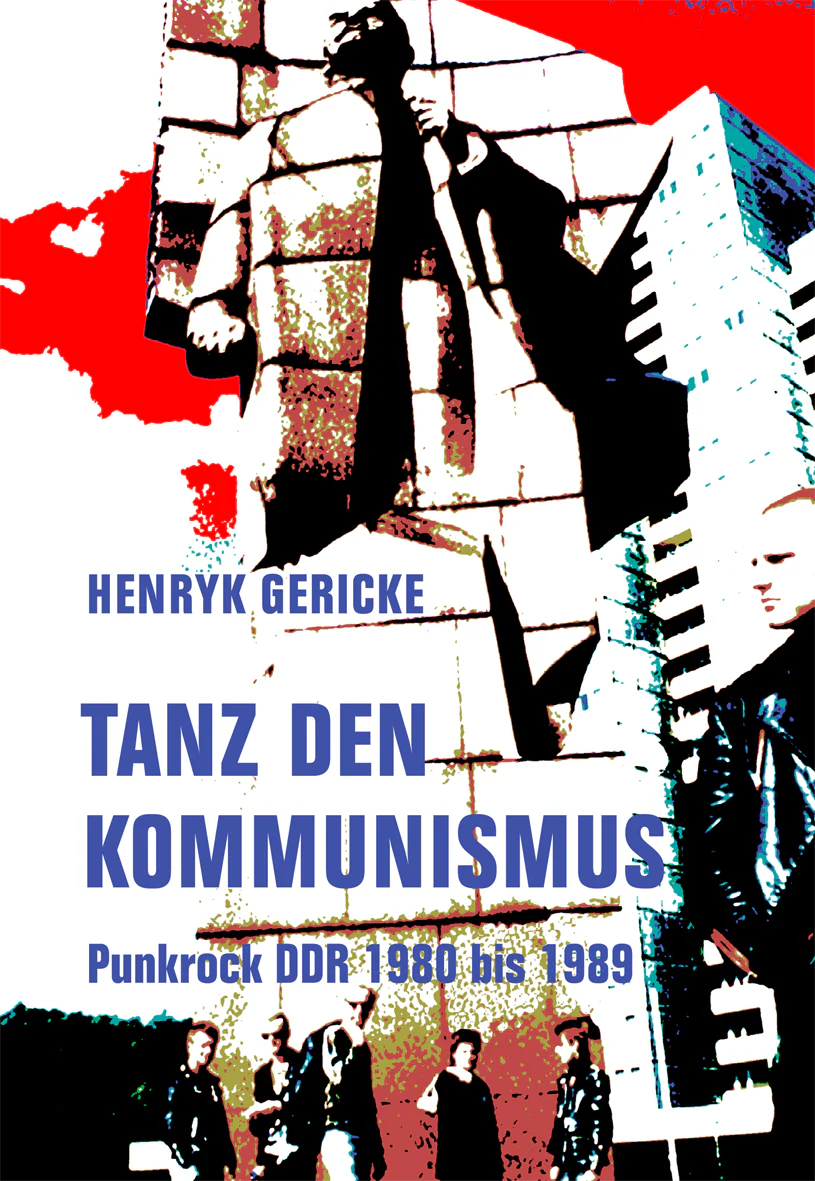
Tanz Den Kommunismus
Between 2005 and 2007, a number of exhibitions, a book and a cinema documentary entitled ‘too much future’ put the spotlight on a chapter of East German subculture and counterculture that had barely been illuminated until then. Since then, a number of publications on the subject of punk rock in the GDR have been published alongside the monotheistic cult of the West German underground of the 1980s. Among the many books that have appeared, there are a few that neither mythologise nor autosuggestively sing the eternal lyre of outdated punk clichés and then reflexively lament the victims. The underground was never a strategy, at least not the punk underground. It was intoxication, elemental violence and an immoral feast for the senses, which you paid for because you gave nothing to the state.
‘Tanz den Kommunismus’ only portrays punk bands that were active in an illegal environment and consistently countered the obligation to be categorised by the state with a drive to play that didn't care about permission. In order to reproduce the soundscapes of a counterculture in texts, it is not enough to limit oneself to working through band histories. The individual portraits make a passionate attempt to create a kaleidoscope that reflects the bands through themselves as well as through their cultural and socio-cultural environment.
Original: $0.03
-67%$0.03
$0.01Tanz Den Kommunismus
Between 2005 and 2007, a number of exhibitions, a book and a cinema documentary entitled ‘too much future’ put the spotlight on a chapter of East German subculture and counterculture that had barely been illuminated until then. Since then, a number of publications on the subject of punk rock in the GDR have been published alongside the monotheistic cult of the West German underground of the 1980s. Among the many books that have appeared, there are a few that neither mythologise nor autosuggestively sing the eternal lyre of outdated punk clichés and then reflexively lament the victims. The underground was never a strategy, at least not the punk underground. It was intoxication, elemental violence and an immoral feast for the senses, which you paid for because you gave nothing to the state.
‘Tanz den Kommunismus’ only portrays punk bands that were active in an illegal environment and consistently countered the obligation to be categorised by the state with a drive to play that didn't care about permission. In order to reproduce the soundscapes of a counterculture in texts, it is not enough to limit oneself to working through band histories. The individual portraits make a passionate attempt to create a kaleidoscope that reflects the bands through themselves as well as through their cultural and socio-cultural environment.
Product Information
Product Information
Shipping & Returns
Shipping & Returns
Description
Between 2005 and 2007, a number of exhibitions, a book and a cinema documentary entitled ‘too much future’ put the spotlight on a chapter of East German subculture and counterculture that had barely been illuminated until then. Since then, a number of publications on the subject of punk rock in the GDR have been published alongside the monotheistic cult of the West German underground of the 1980s. Among the many books that have appeared, there are a few that neither mythologise nor autosuggestively sing the eternal lyre of outdated punk clichés and then reflexively lament the victims. The underground was never a strategy, at least not the punk underground. It was intoxication, elemental violence and an immoral feast for the senses, which you paid for because you gave nothing to the state.
‘Tanz den Kommunismus’ only portrays punk bands that were active in an illegal environment and consistently countered the obligation to be categorised by the state with a drive to play that didn't care about permission. In order to reproduce the soundscapes of a counterculture in texts, it is not enough to limit oneself to working through band histories. The individual portraits make a passionate attempt to create a kaleidoscope that reflects the bands through themselves as well as through their cultural and socio-cultural environment.