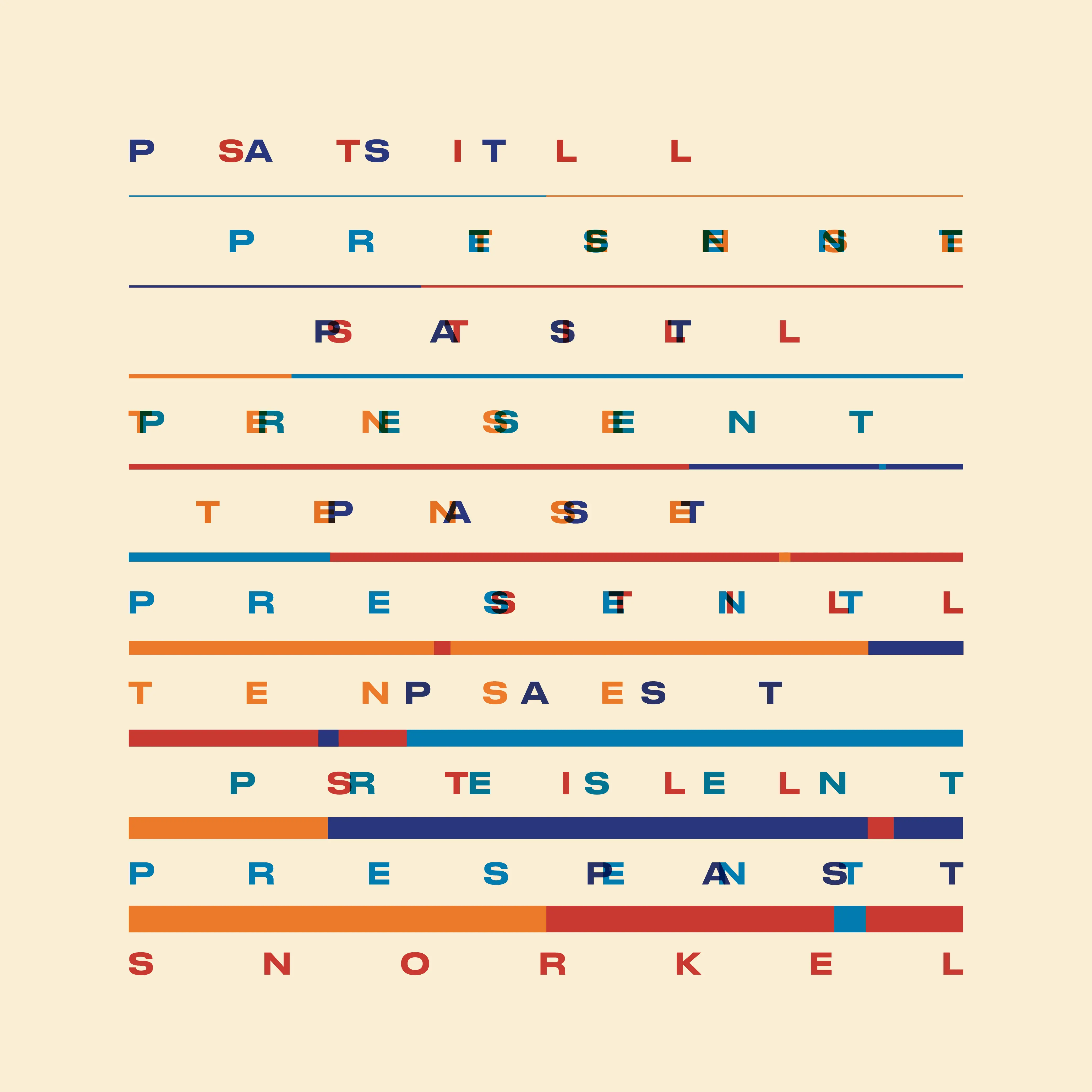
Past Still Present Tense
Past Still Present Tense, the new double album by Snorkel, is in certain respects a retrospective collection. However, as reflected in its title, the group regard the release as a statement about where they are now and the sound of what is next to come. This latest release spans multiple incarnations of the group, drawing fromvarious modes of im provising, recording, editing, and playing to capture their evolving sound and pushes beyond the sound of previous releases.
The album pays homage to the experimental past – to Krautrock, dub, free improv, post-punk, avant funk and afrobeat. However, in its propulsive momentum, its singular flow of fresh sonic permutations, it’s an album constantly moving fast forward to the future NOW. Over its four sides it covers a vast range of inventiveness, varying in mood from the playful to the ominous. Its sheer singularity is reflected in some of the more esoteric instrumental credits: Arp Axxe, Juno 106, Micromoog, Moog Rogue, unprepared guitar, Gyil (Ghanaian xylophone), Dark Star, Microkorg, Farfisa Bravo.
“Night Flight” ignites the album. Frank Byng lays down a percussive intonation, while around him fellow players – including Ben Cowen, Ralph Cumbers, and “129” – sound growling sheets of Moog, analogue patterns, alien wah-wah. Lights flash on and off everywhere, a joyful urgency of sirens, as if aliens have crashed a space station and instigated an interplanetary rave.
‘Ogotemmeli' bears faint tinges of Gamelan but that is superseded by hectic, dubwise electronic chatter, frenetic, treated trombone (Tom Marriott), and cackling synths. Its relentless bass riff, a reminder of Can circa "Mother Upduff’ – pumping, deceptive in its simplicity. ‘Rattled and Snaked’ features ping-pong, primitive dub effects reminiscent of early Cabaret Voltaire and This Heat, especially the latter’s track ’24 Track Loop’ but from that jumping off point, ‘Rattled and Snaked’ splinters off at multiple tangents, electro-rhythmical possibilities, uncharted sound realms. ‘Black Wave Breaks’ sees a shift of mood – solemn Moog/electric reed organ bass line (Charles Stuart), exploratory, arcing Adrian Belew-esque guitar (Roberto Sassi) and breaking over horizon after horizon as its electronic synergy intensifies.
Side two is relentlessly upbeat, breakneck at times. ‘Sirene' is like some alien, future variant on jazz-funk, ‘Word Repellent' is driven by a deep, throbbing pulsation, like giant bellows, triggering an aquarium of variegated responses, from treated trombone to tiny curlicues of electronics. ‘Snacking’s menagerie of noises, all playful and elastic, evokes feeding time at a zoo on Saturn, while ‘Bruised Crews’ is an agile series of electronic and percussive, interactions, sparkling, cackling, spitting, dribbling electricity. 'Flash Flood’ is practically self- descriptive, in its torrential, driving, every which way energy, faintly reminding of Konono Nº1's Congotronics.
There’s an ostensibly funky element to side three. ‘All Before And After All’ sets forth in the manner of some 80s avant-R&B 12 inch, by Bill Laswell’s Material perhaps, before settling into something altogether elegant and ornamental. ‘High’ bears intimations of DAF in its brutally stark electronic patterning before spreading into a more maximal, eventful dubscape. ‘Eat Your Head Out’ starts out like a rereading of Ike & Tina Turner’s "Nutbush City Limits" before transmogrifying, as is Snorkel’s wont, into a mass of wires, treated vocals and flailing limbs. But there’s a transcendent beauty about Snorkel, as on ‘My Friend Electric’, a veritable dance beneath grand chandeliers of dub and the glassy progressions of ‘Clouded Chords’.
Side four and ‘Ground Swell’ signals a shift in mood, more drawn out, alert, the lights dimmed, a distressed signal emitted at irregular intervals. ‘No One Home’ is dominated by a buzzing, bassy riff and indistinct vocal hollering, the track cumulatively adorned with an array of additions, fragments of electronics. ‘Leaving Jet Trails…’ is as close as Snorkel approximate to ambient, casting long Moog shadows and analogue beams, before the percussion clicks into a more motorik gear as the track builds in scale and grandiloquence. Finally, ‘The Wasp Factory’ alights at a near stillness, a glistening, unoccupied vastness, like the surface of an undiscovered moon.
Past Still Present Tense simultaneously tips its hat to the past whilst excitedly stepping forward into new musical directions, as drummer Frank Byng explains:
“Improvisation is the starting point for everything Snorkel – whether we’re playing live or layering overdubs in the studio. Inspired by bands like Can and This Heat, our approach focuses on generating and shaping material through creative experimentation.
Our influences are very broad, with each member bringing unique approaches that develop our vibrant sonic palette, drawing from dub, jazz, electronic music, rock, post-punk, African music, and more. Whilst I think you can hear some of these influences very clearly, when these references are juxtaposed interesting sonic hybrids emerge that defy easy categorisation and hopefully sound fresh and exciting. Past Still Present Tense captures the continuity of Snorkel’s sound through past and present members while embracing fresh energy. Being a double album allowed us to explore many moods: plaintive, abstract, raucous, playful, and at times edgy and sinister. Tracks played live sit alongside studio experiments where only traces of the original remain.
This album is both retrospective and excitingly prospective. We've always seen Snorkel as more of a collective than a band, so releasing this body of music at the point that we are moving forward as a newly convened four-piece feels both appropriate and very exciting.”
Where might Snorkel proceed next? Past Still Present Tense presents 360 degrees of possibilities. They have already staked a celestial claim to the far future, all of their own.
Original: $52.00
-70%$52.00
$15.60Past Still Present Tense
Past Still Present Tense, the new double album by Snorkel, is in certain respects a retrospective collection. However, as reflected in its title, the group regard the release as a statement about where they are now and the sound of what is next to come. This latest release spans multiple incarnations of the group, drawing fromvarious modes of im provising, recording, editing, and playing to capture their evolving sound and pushes beyond the sound of previous releases.
The album pays homage to the experimental past – to Krautrock, dub, free improv, post-punk, avant funk and afrobeat. However, in its propulsive momentum, its singular flow of fresh sonic permutations, it’s an album constantly moving fast forward to the future NOW. Over its four sides it covers a vast range of inventiveness, varying in mood from the playful to the ominous. Its sheer singularity is reflected in some of the more esoteric instrumental credits: Arp Axxe, Juno 106, Micromoog, Moog Rogue, unprepared guitar, Gyil (Ghanaian xylophone), Dark Star, Microkorg, Farfisa Bravo.
“Night Flight” ignites the album. Frank Byng lays down a percussive intonation, while around him fellow players – including Ben Cowen, Ralph Cumbers, and “129” – sound growling sheets of Moog, analogue patterns, alien wah-wah. Lights flash on and off everywhere, a joyful urgency of sirens, as if aliens have crashed a space station and instigated an interplanetary rave.
‘Ogotemmeli' bears faint tinges of Gamelan but that is superseded by hectic, dubwise electronic chatter, frenetic, treated trombone (Tom Marriott), and cackling synths. Its relentless bass riff, a reminder of Can circa "Mother Upduff’ – pumping, deceptive in its simplicity. ‘Rattled and Snaked’ features ping-pong, primitive dub effects reminiscent of early Cabaret Voltaire and This Heat, especially the latter’s track ’24 Track Loop’ but from that jumping off point, ‘Rattled and Snaked’ splinters off at multiple tangents, electro-rhythmical possibilities, uncharted sound realms. ‘Black Wave Breaks’ sees a shift of mood – solemn Moog/electric reed organ bass line (Charles Stuart), exploratory, arcing Adrian Belew-esque guitar (Roberto Sassi) and breaking over horizon after horizon as its electronic synergy intensifies.
Side two is relentlessly upbeat, breakneck at times. ‘Sirene' is like some alien, future variant on jazz-funk, ‘Word Repellent' is driven by a deep, throbbing pulsation, like giant bellows, triggering an aquarium of variegated responses, from treated trombone to tiny curlicues of electronics. ‘Snacking’s menagerie of noises, all playful and elastic, evokes feeding time at a zoo on Saturn, while ‘Bruised Crews’ is an agile series of electronic and percussive, interactions, sparkling, cackling, spitting, dribbling electricity. 'Flash Flood’ is practically self- descriptive, in its torrential, driving, every which way energy, faintly reminding of Konono Nº1's Congotronics.
There’s an ostensibly funky element to side three. ‘All Before And After All’ sets forth in the manner of some 80s avant-R&B 12 inch, by Bill Laswell’s Material perhaps, before settling into something altogether elegant and ornamental. ‘High’ bears intimations of DAF in its brutally stark electronic patterning before spreading into a more maximal, eventful dubscape. ‘Eat Your Head Out’ starts out like a rereading of Ike & Tina Turner’s "Nutbush City Limits" before transmogrifying, as is Snorkel’s wont, into a mass of wires, treated vocals and flailing limbs. But there’s a transcendent beauty about Snorkel, as on ‘My Friend Electric’, a veritable dance beneath grand chandeliers of dub and the glassy progressions of ‘Clouded Chords’.
Side four and ‘Ground Swell’ signals a shift in mood, more drawn out, alert, the lights dimmed, a distressed signal emitted at irregular intervals. ‘No One Home’ is dominated by a buzzing, bassy riff and indistinct vocal hollering, the track cumulatively adorned with an array of additions, fragments of electronics. ‘Leaving Jet Trails…’ is as close as Snorkel approximate to ambient, casting long Moog shadows and analogue beams, before the percussion clicks into a more motorik gear as the track builds in scale and grandiloquence. Finally, ‘The Wasp Factory’ alights at a near stillness, a glistening, unoccupied vastness, like the surface of an undiscovered moon.
Past Still Present Tense simultaneously tips its hat to the past whilst excitedly stepping forward into new musical directions, as drummer Frank Byng explains:
“Improvisation is the starting point for everything Snorkel – whether we’re playing live or layering overdubs in the studio. Inspired by bands like Can and This Heat, our approach focuses on generating and shaping material through creative experimentation.
Our influences are very broad, with each member bringing unique approaches that develop our vibrant sonic palette, drawing from dub, jazz, electronic music, rock, post-punk, African music, and more. Whilst I think you can hear some of these influences very clearly, when these references are juxtaposed interesting sonic hybrids emerge that defy easy categorisation and hopefully sound fresh and exciting. Past Still Present Tense captures the continuity of Snorkel’s sound through past and present members while embracing fresh energy. Being a double album allowed us to explore many moods: plaintive, abstract, raucous, playful, and at times edgy and sinister. Tracks played live sit alongside studio experiments where only traces of the original remain.
This album is both retrospective and excitingly prospective. We've always seen Snorkel as more of a collective than a band, so releasing this body of music at the point that we are moving forward as a newly convened four-piece feels both appropriate and very exciting.”
Where might Snorkel proceed next? Past Still Present Tense presents 360 degrees of possibilities. They have already staked a celestial claim to the far future, all of their own.
Product Information
Product Information
Shipping & Returns
Shipping & Returns
Description
Past Still Present Tense, the new double album by Snorkel, is in certain respects a retrospective collection. However, as reflected in its title, the group regard the release as a statement about where they are now and the sound of what is next to come. This latest release spans multiple incarnations of the group, drawing fromvarious modes of im provising, recording, editing, and playing to capture their evolving sound and pushes beyond the sound of previous releases.
The album pays homage to the experimental past – to Krautrock, dub, free improv, post-punk, avant funk and afrobeat. However, in its propulsive momentum, its singular flow of fresh sonic permutations, it’s an album constantly moving fast forward to the future NOW. Over its four sides it covers a vast range of inventiveness, varying in mood from the playful to the ominous. Its sheer singularity is reflected in some of the more esoteric instrumental credits: Arp Axxe, Juno 106, Micromoog, Moog Rogue, unprepared guitar, Gyil (Ghanaian xylophone), Dark Star, Microkorg, Farfisa Bravo.
“Night Flight” ignites the album. Frank Byng lays down a percussive intonation, while around him fellow players – including Ben Cowen, Ralph Cumbers, and “129” – sound growling sheets of Moog, analogue patterns, alien wah-wah. Lights flash on and off everywhere, a joyful urgency of sirens, as if aliens have crashed a space station and instigated an interplanetary rave.
‘Ogotemmeli' bears faint tinges of Gamelan but that is superseded by hectic, dubwise electronic chatter, frenetic, treated trombone (Tom Marriott), and cackling synths. Its relentless bass riff, a reminder of Can circa "Mother Upduff’ – pumping, deceptive in its simplicity. ‘Rattled and Snaked’ features ping-pong, primitive dub effects reminiscent of early Cabaret Voltaire and This Heat, especially the latter’s track ’24 Track Loop’ but from that jumping off point, ‘Rattled and Snaked’ splinters off at multiple tangents, electro-rhythmical possibilities, uncharted sound realms. ‘Black Wave Breaks’ sees a shift of mood – solemn Moog/electric reed organ bass line (Charles Stuart), exploratory, arcing Adrian Belew-esque guitar (Roberto Sassi) and breaking over horizon after horizon as its electronic synergy intensifies.
Side two is relentlessly upbeat, breakneck at times. ‘Sirene' is like some alien, future variant on jazz-funk, ‘Word Repellent' is driven by a deep, throbbing pulsation, like giant bellows, triggering an aquarium of variegated responses, from treated trombone to tiny curlicues of electronics. ‘Snacking’s menagerie of noises, all playful and elastic, evokes feeding time at a zoo on Saturn, while ‘Bruised Crews’ is an agile series of electronic and percussive, interactions, sparkling, cackling, spitting, dribbling electricity. 'Flash Flood’ is practically self- descriptive, in its torrential, driving, every which way energy, faintly reminding of Konono Nº1's Congotronics.
There’s an ostensibly funky element to side three. ‘All Before And After All’ sets forth in the manner of some 80s avant-R&B 12 inch, by Bill Laswell’s Material perhaps, before settling into something altogether elegant and ornamental. ‘High’ bears intimations of DAF in its brutally stark electronic patterning before spreading into a more maximal, eventful dubscape. ‘Eat Your Head Out’ starts out like a rereading of Ike & Tina Turner’s "Nutbush City Limits" before transmogrifying, as is Snorkel’s wont, into a mass of wires, treated vocals and flailing limbs. But there’s a transcendent beauty about Snorkel, as on ‘My Friend Electric’, a veritable dance beneath grand chandeliers of dub and the glassy progressions of ‘Clouded Chords’.
Side four and ‘Ground Swell’ signals a shift in mood, more drawn out, alert, the lights dimmed, a distressed signal emitted at irregular intervals. ‘No One Home’ is dominated by a buzzing, bassy riff and indistinct vocal hollering, the track cumulatively adorned with an array of additions, fragments of electronics. ‘Leaving Jet Trails…’ is as close as Snorkel approximate to ambient, casting long Moog shadows and analogue beams, before the percussion clicks into a more motorik gear as the track builds in scale and grandiloquence. Finally, ‘The Wasp Factory’ alights at a near stillness, a glistening, unoccupied vastness, like the surface of an undiscovered moon.
Past Still Present Tense simultaneously tips its hat to the past whilst excitedly stepping forward into new musical directions, as drummer Frank Byng explains:
“Improvisation is the starting point for everything Snorkel – whether we’re playing live or layering overdubs in the studio. Inspired by bands like Can and This Heat, our approach focuses on generating and shaping material through creative experimentation.
Our influences are very broad, with each member bringing unique approaches that develop our vibrant sonic palette, drawing from dub, jazz, electronic music, rock, post-punk, African music, and more. Whilst I think you can hear some of these influences very clearly, when these references are juxtaposed interesting sonic hybrids emerge that defy easy categorisation and hopefully sound fresh and exciting. Past Still Present Tense captures the continuity of Snorkel’s sound through past and present members while embracing fresh energy. Being a double album allowed us to explore many moods: plaintive, abstract, raucous, playful, and at times edgy and sinister. Tracks played live sit alongside studio experiments where only traces of the original remain.
This album is both retrospective and excitingly prospective. We've always seen Snorkel as more of a collective than a band, so releasing this body of music at the point that we are moving forward as a newly convened four-piece feels both appropriate and very exciting.”
Where might Snorkel proceed next? Past Still Present Tense presents 360 degrees of possibilities. They have already staked a celestial claim to the far future, all of their own.