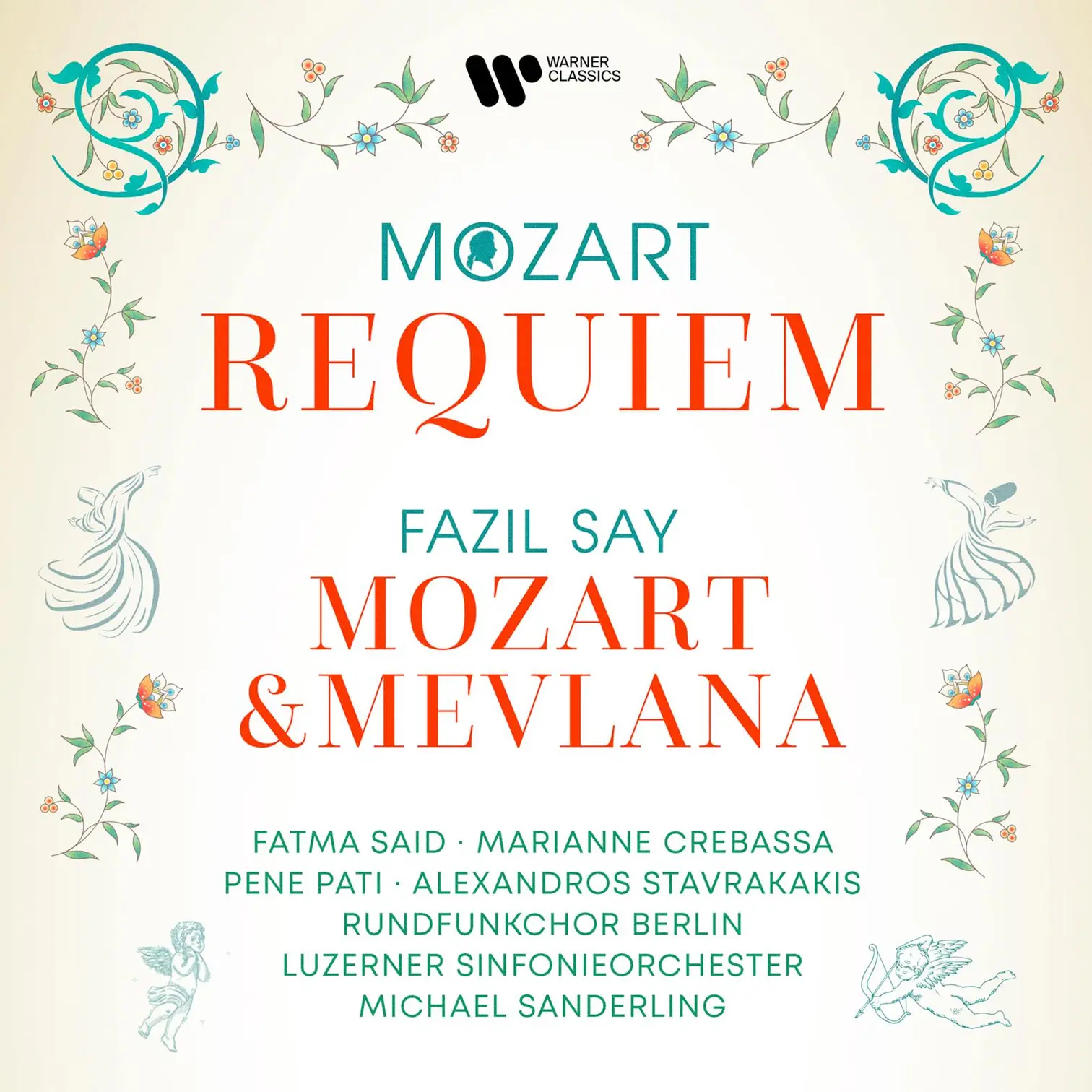
Mozart: Requiem - Say: Mozart and Mevlana
Mozart’s magnificent setting of the Requiem Mass needs no introduction. One of his last works and a landmark of choral music, it is paired on this album with a new and complementary work by the pianist and composer Fazıl Say: Mozart ve Mevlana.
Founded on the same forces as the Mozart Requiem and running for some 25 minutes, Mozart ve Mevlana is a setting of two poems by the 13th century Sufi poet Rumi. It was premiered in November 2024 by the performers on this album: four superb soloists – soprano Fatma Said, mezzo-soprano Marianne Crebassa, tenor Pene Pati and bass Alexandros Stavrakakis – the Rundfunkchor Berlin, the Luzerner Sinfonieorchester and conductor Michael Sanderling.
One of the world’s most widely-read poets, Rumi was born in what is now Afghanistan, but spent much of his life in the city of Konya, located some 270 kilometres south of Turkey’s modern capital Ankara – where Fazıl Say was born. Rumi’s full title in Turkish is Mevlânâ Celâleddîn-i Rûmî (‘Mevlânâ’ denotes ‘Our master’ and Rûmî signals his association with Anatolia). In Mozart ve Mevlana – which means 'Mozart and Mevlana' – Fazıl Say sets poems that were translated into Turkish from the original Persian. Championing tolerance and generosity of spirit, they are ‘Yine Gel’ (‘Come Again’ in English) and ‘Yedi Öğüt’ (‘The Seven Principles”).
Introducing Mozart ve Mevlana, Fazıl Say says: “Mevlana is a great philosopher from the Eastern world – the Orient. I’m from Turkey. I thought: ‘Why not unite East and West in love and friendship through texts from the great philosopher Mevlana and quotations from the music of a composer of genius like Mozart in a fluid musical space? … I play all Mozart’s works for piano and I have recorded them all. So Mozart plays a very special role in my life … Our lives should be spent building bridges of friendship. … We need to try to be friends, to compromise, to make peace … Mozart’s music is the music of humanity. Likewise, Mevlana’s words unite people regardless of their religion or belief.”
In his score Say deploys the same instrumental and vocal forces as Mozart did in his Requiem and makes clear musical references to the Requiem and to other works by Mozart. Beyond that, he integrates instruments, metres and harmonies from Anatolian culture. Closely associated with Sufism, a spiritual and mystical path within Islam, are the ney – a reed flute that holds an important place in Middle Eastern music – and the kudüm, a pair of small, hemispherical drums. “As a philosopher Mevlana also gave voice to his thoughts through music and dance,” adds Say, “Everyone is familiar with the whirling dervishes from Konya, where Mevlana lived.”
Fazıl Say’s relationship with the Luzerner Sinfonieorchester goes back more than 25 years and his extensive Warner Classics catalogue includes his compositions.
Original: $23.99
-70%$23.99
$7.20Mozart: Requiem - Say: Mozart and Mevlana
Mozart’s magnificent setting of the Requiem Mass needs no introduction. One of his last works and a landmark of choral music, it is paired on this album with a new and complementary work by the pianist and composer Fazıl Say: Mozart ve Mevlana.
Founded on the same forces as the Mozart Requiem and running for some 25 minutes, Mozart ve Mevlana is a setting of two poems by the 13th century Sufi poet Rumi. It was premiered in November 2024 by the performers on this album: four superb soloists – soprano Fatma Said, mezzo-soprano Marianne Crebassa, tenor Pene Pati and bass Alexandros Stavrakakis – the Rundfunkchor Berlin, the Luzerner Sinfonieorchester and conductor Michael Sanderling.
One of the world’s most widely-read poets, Rumi was born in what is now Afghanistan, but spent much of his life in the city of Konya, located some 270 kilometres south of Turkey’s modern capital Ankara – where Fazıl Say was born. Rumi’s full title in Turkish is Mevlânâ Celâleddîn-i Rûmî (‘Mevlânâ’ denotes ‘Our master’ and Rûmî signals his association with Anatolia). In Mozart ve Mevlana – which means 'Mozart and Mevlana' – Fazıl Say sets poems that were translated into Turkish from the original Persian. Championing tolerance and generosity of spirit, they are ‘Yine Gel’ (‘Come Again’ in English) and ‘Yedi Öğüt’ (‘The Seven Principles”).
Introducing Mozart ve Mevlana, Fazıl Say says: “Mevlana is a great philosopher from the Eastern world – the Orient. I’m from Turkey. I thought: ‘Why not unite East and West in love and friendship through texts from the great philosopher Mevlana and quotations from the music of a composer of genius like Mozart in a fluid musical space? … I play all Mozart’s works for piano and I have recorded them all. So Mozart plays a very special role in my life … Our lives should be spent building bridges of friendship. … We need to try to be friends, to compromise, to make peace … Mozart’s music is the music of humanity. Likewise, Mevlana’s words unite people regardless of their religion or belief.”
In his score Say deploys the same instrumental and vocal forces as Mozart did in his Requiem and makes clear musical references to the Requiem and to other works by Mozart. Beyond that, he integrates instruments, metres and harmonies from Anatolian culture. Closely associated with Sufism, a spiritual and mystical path within Islam, are the ney – a reed flute that holds an important place in Middle Eastern music – and the kudüm, a pair of small, hemispherical drums. “As a philosopher Mevlana also gave voice to his thoughts through music and dance,” adds Say, “Everyone is familiar with the whirling dervishes from Konya, where Mevlana lived.”
Fazıl Say’s relationship with the Luzerner Sinfonieorchester goes back more than 25 years and his extensive Warner Classics catalogue includes his compositions.
Product Information
Product Information
Shipping & Returns
Shipping & Returns
Description
Mozart’s magnificent setting of the Requiem Mass needs no introduction. One of his last works and a landmark of choral music, it is paired on this album with a new and complementary work by the pianist and composer Fazıl Say: Mozart ve Mevlana.
Founded on the same forces as the Mozart Requiem and running for some 25 minutes, Mozart ve Mevlana is a setting of two poems by the 13th century Sufi poet Rumi. It was premiered in November 2024 by the performers on this album: four superb soloists – soprano Fatma Said, mezzo-soprano Marianne Crebassa, tenor Pene Pati and bass Alexandros Stavrakakis – the Rundfunkchor Berlin, the Luzerner Sinfonieorchester and conductor Michael Sanderling.
One of the world’s most widely-read poets, Rumi was born in what is now Afghanistan, but spent much of his life in the city of Konya, located some 270 kilometres south of Turkey’s modern capital Ankara – where Fazıl Say was born. Rumi’s full title in Turkish is Mevlânâ Celâleddîn-i Rûmî (‘Mevlânâ’ denotes ‘Our master’ and Rûmî signals his association with Anatolia). In Mozart ve Mevlana – which means 'Mozart and Mevlana' – Fazıl Say sets poems that were translated into Turkish from the original Persian. Championing tolerance and generosity of spirit, they are ‘Yine Gel’ (‘Come Again’ in English) and ‘Yedi Öğüt’ (‘The Seven Principles”).
Introducing Mozart ve Mevlana, Fazıl Say says: “Mevlana is a great philosopher from the Eastern world – the Orient. I’m from Turkey. I thought: ‘Why not unite East and West in love and friendship through texts from the great philosopher Mevlana and quotations from the music of a composer of genius like Mozart in a fluid musical space? … I play all Mozart’s works for piano and I have recorded them all. So Mozart plays a very special role in my life … Our lives should be spent building bridges of friendship. … We need to try to be friends, to compromise, to make peace … Mozart’s music is the music of humanity. Likewise, Mevlana’s words unite people regardless of their religion or belief.”
In his score Say deploys the same instrumental and vocal forces as Mozart did in his Requiem and makes clear musical references to the Requiem and to other works by Mozart. Beyond that, he integrates instruments, metres and harmonies from Anatolian culture. Closely associated with Sufism, a spiritual and mystical path within Islam, are the ney – a reed flute that holds an important place in Middle Eastern music – and the kudüm, a pair of small, hemispherical drums. “As a philosopher Mevlana also gave voice to his thoughts through music and dance,” adds Say, “Everyone is familiar with the whirling dervishes from Konya, where Mevlana lived.”
Fazıl Say’s relationship with the Luzerner Sinfonieorchester goes back more than 25 years and his extensive Warner Classics catalogue includes his compositions.