Modern Night
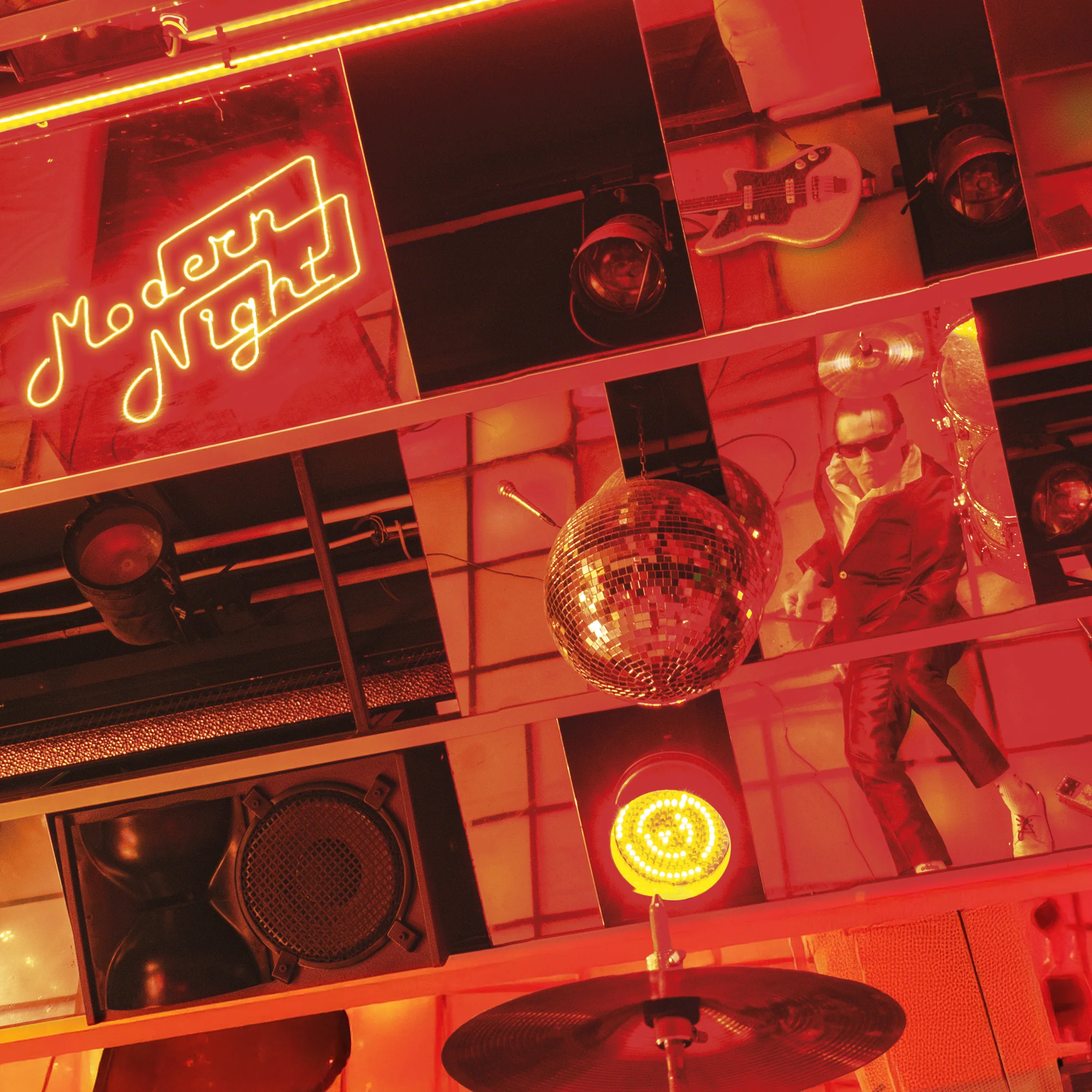
A flickering neon light reflects off empty carnival rides. The town is quiet… too quiet. Somewhere in the distance, a jukebox plays a love song, slightly warped. In the silence of an off-season Riviera, a figure walks alone through the shadows of a provincial night, dressed in velvet melancholy and faded glamour. It looks like a Fellini movie, but something eerie is approaching. While the streets are empty, a ghosts whisper from the corners. This is where Alex Fernet tells his Modern Night. Fernet’s sophomore album for Bronson Recordings is a vampiric seduction that merges ‘post’: soul, funk, italodisco, and new wave with a noir cinematic aesthetic—linking David Bowie to Gaznevada and David Sylvian, Scott Walker to The Human League and the Style Council. Written, performed, and produced by Fernet himself, Modern Night was recorded at Duna Studio in Ravenna and later mixed and mastered by Maurizio “Icio” Baggio (The Soft Moon, Boy Harsher), whose touch enhances its spectral clarity and analog warmth.
“I wanted this record to feel like a dark soul album,” Fernet explains. “A place where echoing pianos, rebel angels, and ‘60s ghosts meet minor chords and broken-down synths. Where the funk doesn’t smile—it disappears down an alley in search of something it lost.” If there’s a narrative thread that binds Modern Night, it’s the character of the Sunlight Vampire, introduced in the first single of the same name. Half-metaphor, half-ghost, this figure roams the album’s ten tracks, transforming nostalgia into a political act and melancholy into a form of resistance. This isn’t simply hauntology in sound, but in posture: a refusal to accept the shiny surfaces and forced optimism of the present.
With The Nightdrive, Fernet moves further into the urban subconscious, crafting what he calls the album’s manifesto. The track is part soundtrack, part hallucination—a night ride through deserted streets, where the headlights don’t quite pierce the fog. Its atmosphere conjures the tension of The Twilight Zone, the loneliness of late-night TV reruns, the flicker of provincial disco lights long after the music has stopped.
The third single, Hey Lady, is more intimate: a whispered confession in a smoke-filled lounge. There’s romance here, but it’s disillusioned, filtered through VHS fuzz and draped in the kind of synth-pop sadness you might hear from a car stereo in 1983, parked outside a closed-down bowling alley. The focus track, Comfort Zone, is perhaps the album’s most paradoxical gesture. Set in Fernet’s imagined hometown—part real, part dream—it feels both warm and alien. The song’s layered textures capture the beauty and strangeness of returning to a place that’s no longer yours, or perhaps never was. It’s home, but it’s haunted.
Musically, Modern Night defies easy categorization. There are echoes of AOR radio ballads, post-industrial funk, and soul music stripped of optimism. Think of it as future nostalgia with dirt under its fingernails: a deeply contemporary work that rejects digital perfection in favor of analog imperfection. As Fernet puts it: “In an era of over-edited sound, the most radical act might be to let things breathe.” The production choices reflect this ethos. Drums, performed by Diego Dal Bon (Crocodiles, Jennifer Gentle), were recorded as full takes—raw and hypnotic. Piano contributions from Little Albert (Messa) add a spectral shimmer. And Fernet himself, tireless during the artist residency that birthed the album, spent ten days in near-total isolation in the Romagna lowlands—immersed in fog, trattorias, and VHS dreams.
“I wanted a sound that felt current, but produced through old-school techniques,” Fernet says. “Even though many of the references come from the past,” he continues, “their combination and reinvention can still generate something new.”
On Be My Memory, a torch song that plays with cinematic archetypes, Fernet inhabits the role of Flavières from Hitchcock’s Vertigo, soundtracked by Prefab Sprout—dragging themes of obsession and loss into the 21st century. In Ruins and Wrecks, the ghosts are more abstract, while Spit the Song is a rapturous outburst of pure emotion: equal parts Style Council defiance and Gary Numan’s post-punk anxiety.
There’s a strange beauty in the contradictions Fernet embraces: a desire for connection in the age of alienation, a funk record about ghosts, a soul album about solitude. He doesn’t copy the past—he reanimates it. The result is an LP that feels completely his own. Modern Night is a haunted and urgent piece of music. In a world of hyper-curated personas and algorithmic taste, Alex Fernet’s music arrives like a message scrawled on a crumbling underpass wall: real, strange, and impossible to ignore.
It doesn’t long for the past. It invites the past in—and lets it dance.
Modern Night
A flickering neon light reflects off empty carnival rides. The town is quiet… too quiet. Somewhere in the distance, a jukebox plays a love song, slightly warped. In the silence of an off-season Riviera, a figure walks alone through the shadows of a provincial night, dressed in velvet melancholy and faded glamour. It looks like a Fellini movie, but something eerie is approaching. While the streets are empty, a ghosts whisper from the corners. This is where Alex Fernet tells his Modern Night. Fernet’s sophomore album for Bronson Recordings is a vampiric seduction that merges ‘post’: soul, funk, italodisco, and new wave with a noir cinematic aesthetic—linking David Bowie to Gaznevada and David Sylvian, Scott Walker to The Human League and the Style Council. Written, performed, and produced by Fernet himself, Modern Night was recorded at Duna Studio in Ravenna and later mixed and mastered by Maurizio “Icio” Baggio (The Soft Moon, Boy Harsher), whose touch enhances its spectral clarity and analog warmth.
“I wanted this record to feel like a dark soul album,” Fernet explains. “A place where echoing pianos, rebel angels, and ‘60s ghosts meet minor chords and broken-down synths. Where the funk doesn’t smile—it disappears down an alley in search of something it lost.” If there’s a narrative thread that binds Modern Night, it’s the character of the Sunlight Vampire, introduced in the first single of the same name. Half-metaphor, half-ghost, this figure roams the album’s ten tracks, transforming nostalgia into a political act and melancholy into a form of resistance. This isn’t simply hauntology in sound, but in posture: a refusal to accept the shiny surfaces and forced optimism of the present.
With The Nightdrive, Fernet moves further into the urban subconscious, crafting what he calls the album’s manifesto. The track is part soundtrack, part hallucination—a night ride through deserted streets, where the headlights don’t quite pierce the fog. Its atmosphere conjures the tension of The Twilight Zone, the loneliness of late-night TV reruns, the flicker of provincial disco lights long after the music has stopped.
The third single, Hey Lady, is more intimate: a whispered confession in a smoke-filled lounge. There’s romance here, but it’s disillusioned, filtered through VHS fuzz and draped in the kind of synth-pop sadness you might hear from a car stereo in 1983, parked outside a closed-down bowling alley. The focus track, Comfort Zone, is perhaps the album’s most paradoxical gesture. Set in Fernet’s imagined hometown—part real, part dream—it feels both warm and alien. The song’s layered textures capture the beauty and strangeness of returning to a place that’s no longer yours, or perhaps never was. It’s home, but it’s haunted.
Musically, Modern Night defies easy categorization. There are echoes of AOR radio ballads, post-industrial funk, and soul music stripped of optimism. Think of it as future nostalgia with dirt under its fingernails: a deeply contemporary work that rejects digital perfection in favor of analog imperfection. As Fernet puts it: “In an era of over-edited sound, the most radical act might be to let things breathe.” The production choices reflect this ethos. Drums, performed by Diego Dal Bon (Crocodiles, Jennifer Gentle), were recorded as full takes—raw and hypnotic. Piano contributions from Little Albert (Messa) add a spectral shimmer. And Fernet himself, tireless during the artist residency that birthed the album, spent ten days in near-total isolation in the Romagna lowlands—immersed in fog, trattorias, and VHS dreams.
“I wanted a sound that felt current, but produced through old-school techniques,” Fernet says. “Even though many of the references come from the past,” he continues, “their combination and reinvention can still generate something new.”
On Be My Memory, a torch song that plays with cinematic archetypes, Fernet inhabits the role of Flavières from Hitchcock’s Vertigo, soundtracked by Prefab Sprout—dragging themes of obsession and loss into the 21st century. In Ruins and Wrecks, the ghosts are more abstract, while Spit the Song is a rapturous outburst of pure emotion: equal parts Style Council defiance and Gary Numan’s post-punk anxiety.
There’s a strange beauty in the contradictions Fernet embraces: a desire for connection in the age of alienation, a funk record about ghosts, a soul album about solitude. He doesn’t copy the past—he reanimates it. The result is an LP that feels completely his own. Modern Night is a haunted and urgent piece of music. In a world of hyper-curated personas and algorithmic taste, Alex Fernet’s music arrives like a message scrawled on a crumbling underpass wall: real, strange, and impossible to ignore.
It doesn’t long for the past. It invites the past in—and lets it dance.
Product Information
Product Information
Shipping & Returns
Shipping & Returns
Description
A flickering neon light reflects off empty carnival rides. The town is quiet… too quiet. Somewhere in the distance, a jukebox plays a love song, slightly warped. In the silence of an off-season Riviera, a figure walks alone through the shadows of a provincial night, dressed in velvet melancholy and faded glamour. It looks like a Fellini movie, but something eerie is approaching. While the streets are empty, a ghosts whisper from the corners. This is where Alex Fernet tells his Modern Night. Fernet’s sophomore album for Bronson Recordings is a vampiric seduction that merges ‘post’: soul, funk, italodisco, and new wave with a noir cinematic aesthetic—linking David Bowie to Gaznevada and David Sylvian, Scott Walker to The Human League and the Style Council. Written, performed, and produced by Fernet himself, Modern Night was recorded at Duna Studio in Ravenna and later mixed and mastered by Maurizio “Icio” Baggio (The Soft Moon, Boy Harsher), whose touch enhances its spectral clarity and analog warmth.
“I wanted this record to feel like a dark soul album,” Fernet explains. “A place where echoing pianos, rebel angels, and ‘60s ghosts meet minor chords and broken-down synths. Where the funk doesn’t smile—it disappears down an alley in search of something it lost.” If there’s a narrative thread that binds Modern Night, it’s the character of the Sunlight Vampire, introduced in the first single of the same name. Half-metaphor, half-ghost, this figure roams the album’s ten tracks, transforming nostalgia into a political act and melancholy into a form of resistance. This isn’t simply hauntology in sound, but in posture: a refusal to accept the shiny surfaces and forced optimism of the present.
With The Nightdrive, Fernet moves further into the urban subconscious, crafting what he calls the album’s manifesto. The track is part soundtrack, part hallucination—a night ride through deserted streets, where the headlights don’t quite pierce the fog. Its atmosphere conjures the tension of The Twilight Zone, the loneliness of late-night TV reruns, the flicker of provincial disco lights long after the music has stopped.
The third single, Hey Lady, is more intimate: a whispered confession in a smoke-filled lounge. There’s romance here, but it’s disillusioned, filtered through VHS fuzz and draped in the kind of synth-pop sadness you might hear from a car stereo in 1983, parked outside a closed-down bowling alley. The focus track, Comfort Zone, is perhaps the album’s most paradoxical gesture. Set in Fernet’s imagined hometown—part real, part dream—it feels both warm and alien. The song’s layered textures capture the beauty and strangeness of returning to a place that’s no longer yours, or perhaps never was. It’s home, but it’s haunted.
Musically, Modern Night defies easy categorization. There are echoes of AOR radio ballads, post-industrial funk, and soul music stripped of optimism. Think of it as future nostalgia with dirt under its fingernails: a deeply contemporary work that rejects digital perfection in favor of analog imperfection. As Fernet puts it: “In an era of over-edited sound, the most radical act might be to let things breathe.” The production choices reflect this ethos. Drums, performed by Diego Dal Bon (Crocodiles, Jennifer Gentle), were recorded as full takes—raw and hypnotic. Piano contributions from Little Albert (Messa) add a spectral shimmer. And Fernet himself, tireless during the artist residency that birthed the album, spent ten days in near-total isolation in the Romagna lowlands—immersed in fog, trattorias, and VHS dreams.
“I wanted a sound that felt current, but produced through old-school techniques,” Fernet says. “Even though many of the references come from the past,” he continues, “their combination and reinvention can still generate something new.”
On Be My Memory, a torch song that plays with cinematic archetypes, Fernet inhabits the role of Flavières from Hitchcock’s Vertigo, soundtracked by Prefab Sprout—dragging themes of obsession and loss into the 21st century. In Ruins and Wrecks, the ghosts are more abstract, while Spit the Song is a rapturous outburst of pure emotion: equal parts Style Council defiance and Gary Numan’s post-punk anxiety.
There’s a strange beauty in the contradictions Fernet embraces: a desire for connection in the age of alienation, a funk record about ghosts, a soul album about solitude. He doesn’t copy the past—he reanimates it. The result is an LP that feels completely his own. Modern Night is a haunted and urgent piece of music. In a world of hyper-curated personas and algorithmic taste, Alex Fernet’s music arrives like a message scrawled on a crumbling underpass wall: real, strange, and impossible to ignore.
It doesn’t long for the past. It invites the past in—and lets it dance.