East-West (Mobile Fidelity Pressing)
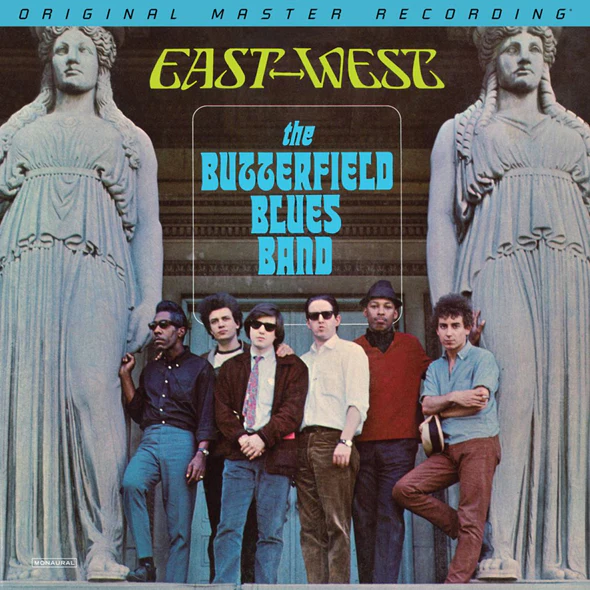
The Butterfield Blues Band might be most famous for serving as the backing group for Bob Dylan’s famous electrified show at the Newport Folk Festival, but the collective earned a spot in the Rock and Roll Hall of Fame due to East-West. Though it remains a footnote in many historical narratives, the 1966 record changed the shape of popular music, sowed the seeds for acid-rock, and further demonstrated the visionary abilities and virtuosic skills of a sextet that took the blues in novel directions.
Sourced from the original analogue master tapes, pressed at Fidelity Record Pressing, and housed in a Stoughton jacket, Mobile Fidelity’s numbered-edition 180g 33RPM LP presents East-West in definitive sound — and in the original mono mix for the first time in nearly 60 years. East-West was pressed in mono from 1966 to 1968, after which the stereo version (a revised copy of the mono original) became the only option.
Playing with incredible naturalism, revealing openness, and in-the-room liveliness, Paul Butterfield and Co.’s creations unfurl here with previously unheard definition, richness, and presence. Every aspect of the album benefits from newfound balance, symmetry, and airiness. Butterfield’s strong lead vocals and signature harmonica; Elvin Bishop’s fusion of gospel, R&B, and country threads; Jerome Arnold’s in-the-pocket bass; Billy Davenport’s bossanova-derived drumming; Mark Naftalin’s illuminating piano and organ; and of course, Mike Bloomfield’s zinging electric guitar. All come across with emotion-triggering realism and responsiveness.
Carrying over most of the same personnel responsible for its stellar eponymous debut, the Butterfield Blues Band made one key change for East-West by inviting drummer Davenport into the fold. His impact on the group’s approaches proved immense. Showcasing refined, delicate, and articulate techniques, and able to underpin the songs with a jazz-driven sense of movement, Davenport allowed the band to improvise. His rhythmic shading, coloring, and control blew open the doors of possibility that other blues ensembles never knew.
East-West also signifies one other important evolution. Spearheaded by its namesake leader, the group became a more democratic outlet in which every member enjoyed meaningful input. Benefitting from such freedom and trust, the instrumentalists turn in peak performances that display the hallmarks of exceptional interplay, chemistry, and communication. Listen to how they glide, sweep, and sway during a melancholic rendition of the traditional blues “I Got a Mind to Give Up Living” and how they swing, skate, and shake on a greasy interpretation of Muddy Waters’ “Two Trains Running.”
Original: $60.01
-70%$60.01
$18.00East-West (Mobile Fidelity Pressing)
The Butterfield Blues Band might be most famous for serving as the backing group for Bob Dylan’s famous electrified show at the Newport Folk Festival, but the collective earned a spot in the Rock and Roll Hall of Fame due to East-West. Though it remains a footnote in many historical narratives, the 1966 record changed the shape of popular music, sowed the seeds for acid-rock, and further demonstrated the visionary abilities and virtuosic skills of a sextet that took the blues in novel directions.
Sourced from the original analogue master tapes, pressed at Fidelity Record Pressing, and housed in a Stoughton jacket, Mobile Fidelity’s numbered-edition 180g 33RPM LP presents East-West in definitive sound — and in the original mono mix for the first time in nearly 60 years. East-West was pressed in mono from 1966 to 1968, after which the stereo version (a revised copy of the mono original) became the only option.
Playing with incredible naturalism, revealing openness, and in-the-room liveliness, Paul Butterfield and Co.’s creations unfurl here with previously unheard definition, richness, and presence. Every aspect of the album benefits from newfound balance, symmetry, and airiness. Butterfield’s strong lead vocals and signature harmonica; Elvin Bishop’s fusion of gospel, R&B, and country threads; Jerome Arnold’s in-the-pocket bass; Billy Davenport’s bossanova-derived drumming; Mark Naftalin’s illuminating piano and organ; and of course, Mike Bloomfield’s zinging electric guitar. All come across with emotion-triggering realism and responsiveness.
Carrying over most of the same personnel responsible for its stellar eponymous debut, the Butterfield Blues Band made one key change for East-West by inviting drummer Davenport into the fold. His impact on the group’s approaches proved immense. Showcasing refined, delicate, and articulate techniques, and able to underpin the songs with a jazz-driven sense of movement, Davenport allowed the band to improvise. His rhythmic shading, coloring, and control blew open the doors of possibility that other blues ensembles never knew.
East-West also signifies one other important evolution. Spearheaded by its namesake leader, the group became a more democratic outlet in which every member enjoyed meaningful input. Benefitting from such freedom and trust, the instrumentalists turn in peak performances that display the hallmarks of exceptional interplay, chemistry, and communication. Listen to how they glide, sweep, and sway during a melancholic rendition of the traditional blues “I Got a Mind to Give Up Living” and how they swing, skate, and shake on a greasy interpretation of Muddy Waters’ “Two Trains Running.”
Product Information
Product Information
Shipping & Returns
Shipping & Returns
Description
The Butterfield Blues Band might be most famous for serving as the backing group for Bob Dylan’s famous electrified show at the Newport Folk Festival, but the collective earned a spot in the Rock and Roll Hall of Fame due to East-West. Though it remains a footnote in many historical narratives, the 1966 record changed the shape of popular music, sowed the seeds for acid-rock, and further demonstrated the visionary abilities and virtuosic skills of a sextet that took the blues in novel directions.
Sourced from the original analogue master tapes, pressed at Fidelity Record Pressing, and housed in a Stoughton jacket, Mobile Fidelity’s numbered-edition 180g 33RPM LP presents East-West in definitive sound — and in the original mono mix for the first time in nearly 60 years. East-West was pressed in mono from 1966 to 1968, after which the stereo version (a revised copy of the mono original) became the only option.
Playing with incredible naturalism, revealing openness, and in-the-room liveliness, Paul Butterfield and Co.’s creations unfurl here with previously unheard definition, richness, and presence. Every aspect of the album benefits from newfound balance, symmetry, and airiness. Butterfield’s strong lead vocals and signature harmonica; Elvin Bishop’s fusion of gospel, R&B, and country threads; Jerome Arnold’s in-the-pocket bass; Billy Davenport’s bossanova-derived drumming; Mark Naftalin’s illuminating piano and organ; and of course, Mike Bloomfield’s zinging electric guitar. All come across with emotion-triggering realism and responsiveness.
Carrying over most of the same personnel responsible for its stellar eponymous debut, the Butterfield Blues Band made one key change for East-West by inviting drummer Davenport into the fold. His impact on the group’s approaches proved immense. Showcasing refined, delicate, and articulate techniques, and able to underpin the songs with a jazz-driven sense of movement, Davenport allowed the band to improvise. His rhythmic shading, coloring, and control blew open the doors of possibility that other blues ensembles never knew.
East-West also signifies one other important evolution. Spearheaded by its namesake leader, the group became a more democratic outlet in which every member enjoyed meaningful input. Benefitting from such freedom and trust, the instrumentalists turn in peak performances that display the hallmarks of exceptional interplay, chemistry, and communication. Listen to how they glide, sweep, and sway during a melancholic rendition of the traditional blues “I Got a Mind to Give Up Living” and how they swing, skate, and shake on a greasy interpretation of Muddy Waters’ “Two Trains Running.”